Hospital In the Home - the costs and benefits of Hospital In The Home compared to Hospital Stay
My main research questions for this project were, "What is the difference between being admitted into Hospital In The Home compared with being admitted into a general hospital?", "What services does Hospital In The Home provide for patients?" and "What are the benefits f being in Hospital In The Home?" From there, I explored a variety of follow-up questions, including what Hospital In The Home actually is, what qualifications are needed to work within it, who first developed the idea, whether it exists outside of Canberra, and how someone can be admitted into the Hospital In The Home program. I chose this topic because it was a program that I was admitted into earlier that year due to medical problems that needed to be addressed over a period of time that required me to be in hospital over that time, but instead I got admitted into this program. I also chose tis topic because I was interested in understanding how people can receive hospital-level care without having to remain in a hospital building. I also wanted to understand whether receiving care at home could make patients feel more comfortable while still giving them access to the treatment and support they need.
The research that I used for this project involved looking at how Hospital In The Home works and how it differs from being admitted into a general hospital. I researched the types of services that can provided at home, the healthcare professionals involved, and the qualifications that may be needed to work in this area. I also looked at the benefits of Hospital In The Home, including patient comfort, independence, and being able to stay in a familiar environment. Another part of my research involved looking at how patients re referred or admitted into Hospital In The Home, what factors determine whether someone is suitable, and whether it can be difficult to access. I also explored whether Hospital In The Home is only available in Canberra or whether similar programs operate in other parts of Australia and around the world.
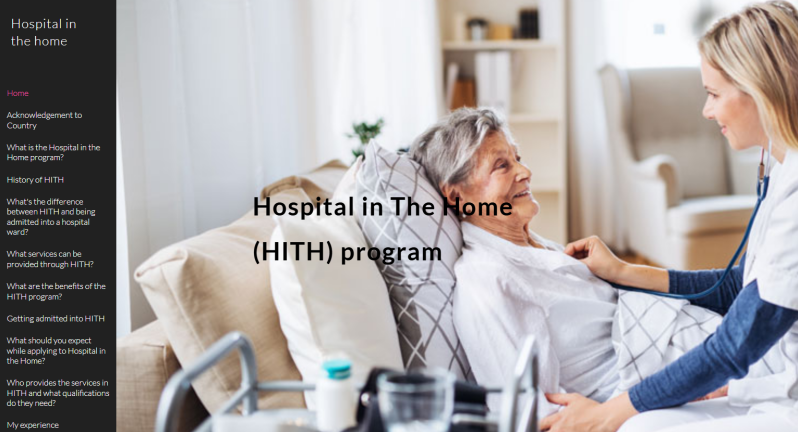
As part of my project, I created a professional website that compared Hospital In The Home with traditional hospital admissions. I included information about the services provided, the admission process, the healthcare workers involved, and the possible benefits and limitations of receiving hospital care at home. I wanted my final product to clearly show how Hospital In The Home works and why it may be a suitable option for some patients.
I leant that Hospital In The Home is so much more than simply receiving basic care at home. It can involve hospital-level treatment, monitoring, and support while still allowing patients to remain in the comfort of their own home. I also learnt that not every patient is suitable for Hospital In The Home and that their medical condition, safety, home environment, and level of support all needed to be considered. Another big thing thing that I learnt was that Hospital In The Home is not just in Canberra, it is based all around the world and was still expanding. This helped me understand how healthcare can be delivered in different ways depending on a person's needs.
Some of the feedback that I received was that the topic was very interesting because many people were not very familiar with this program and how it worked (neither was I until I was in there myself). I was encouraged to look into more of the mental health side of things and the difference between being in Hospital In The Home compared to general admissions for hospital, looking at how the mental well-being of the patient can change. I was also told to make sure to explain that Hospital In The Home is still a formal medical service rather than simple general home care.
The Big Picture Learning Goals that I addressed in this topic was Communication, Social Reasoning, Empirical Reasoning, and Quantitative Reasoning. I used communication throughout my presentation and research when explaining how Hospital In The Home works. I used social Reasoning when looking ay how home-based care can affect a patient's comfort, independence, family life, and overall experience of healthcare. I used Empirical Reasoning when researching the services provided, the admission process, the healthcare professionals involved, and the benefits and limitations of the program. I used Quantitative Reasoning when looking at information such as hospital stay lengths, patient numbers, costs, and other statistics relating to Hospital In The Home.
If I were to complete this project again, I would include more first hand-experiences from patients and healthcare workers who have been involved with Hospital In The Home. I would also compare different Hospital In The Home programs across Australia and internationally to see how they operate differently. Looking back, I an set=e that this project helped me understand that hospital care does not always have to take place inside a hospital and that different models of care can be used to support patients depending on their individual needs and circumstances.


Planning

Research

Bibliography